Play the man, Master Ridley
The expression "Play the man, Master Ridley" is a historical quotation from the martyrdom of Hugh Latimer and Nicholas Ridley, recited by an old woman as she prepares to burn alive with her books, and later identified by Captain Beatty, revealing his erudition and the depth of the book-burning society's repression.
Origin and Context
The phrase originates from the martyrdom of Hugh Latimer and Nicholas Ridley, who were burned at the stake for heresy at Oxford on October 16, 1555. According to historical record, Latimer said to Ridley, "Play the man, Master Ridley; we shall this day light such a candle, by God's grace, in England, as I trust shall never be put out." The words are a call to courage in the face of death, and a prophecy that their sacrifice will illuminate the truth.
Recitation by the Old Woman
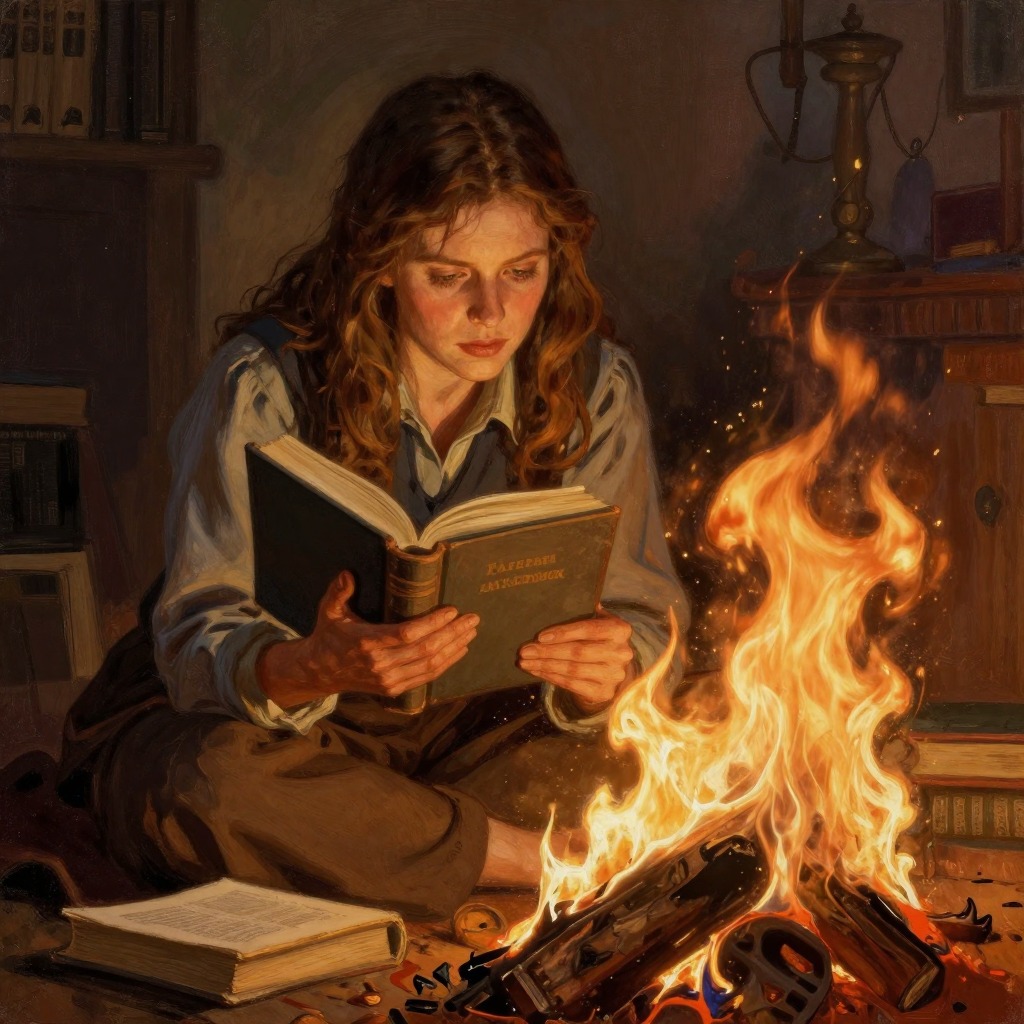
When Montag and the other firemen arrive at a house to burn a cache of books, they find an old woman who refuses to leave. As they enter, she is standing, weaving from side to side, her eyes fixed on nothingness, and her tongue moving. She recites the quotation: "'Play the man, Master Ridley; we shall this day light such a candle, by God's grace, in England, as I trust shall never be put out.'" Captain Beatty immediately slaps her face and repeats the question of where the books are. The woman later chooses to stay in the house and, with a kitchen match, sets herself and the books ablaze, dying in the fire. Her recitation thus becomes her own defiant last words, equating her sacrifice with that of the Protestant martyrs.
Identification by Captain Beatty
After the fire, as the firemen ride back to the firehouse in silence, Montag repeats the phrase "Master Ridley" to himself. Beatty overhears and completes the quotation, identifying its source: "'We shall this day light such a candle, by God's grace, in England, as I trust shall never be put out,'" said Beatty. He then explains that "A man named Latimer said that to a man named Nicholas Ridley, as they were being burnt alive at Oxford, for heresy, on October 16, 1555." This moment reveals Beatty's extensive knowledge of literature and history, which he has acquired through reading—the very act he enforces as a crime. It also underscores the irony that the fire captain, who burns books for a living, is himself well-read, and that the old woman's quotation is a direct challenge to the regime he represents.
Significance
The quotation functions as a powerful symbol of resistance and martyrdom. The old woman's use of it aligns her with a tradition of those who die for their beliefs, and her death becomes a kind of "candle" that illuminates Montag's conscience. Beatty's ability to identify and explain the quotation demonstrates that the system's enforcers are not ignorant, but actively suppress knowledge they themselves possess. The phrase thus encapsulates the central conflict of the novel: the struggle between the oppressive state and the individual's right to knowledge and truth.